A practical guide to Restaurant Inventory Management
Inventory management means knowing what stock you hold, what it cost and what it should be, so you order to need and catch losses within a week instead of at year end.

The short answer
List it, check it in, store it, order to par, count on a fixed day
Then compare what you used with what you sold. Example: opening stock A$6,000 + purchases A$14,000 − closing stock A$5,000 = A$15,000 of stock used in the month.
Jump to the guide ↓01 / What you are managing
Stock Is Cash on a Shelf
Restaurant inventory management is the routine that keeps the right amount of food, drink and packaging in the building: a list of what you stock, checks when it arrives, storage that uses the oldest first, orders to a set level, and counts on a fixed day that you compare with sales. Done weekly, it tells you within days when stock is going missing, going off or piling up.
Paul puts the stakes simply: "your big cost is whatever's on the shelf, your wastage and your portion control." Every carton in the dry store was paid for before it earned anything. Too much stock ties up cash and goes off; too little means a dish comes off the menu mid-service.
[[wrap:cols]]
Perpetual inventory
A running balance for each item: deliveries added, usage taken off. In small operations it is usually kept only for expensive items, because keeping it up takes time.[1]
Physical inventory
Counting everything on the shelves at set intervals and valuing it. A culinary management textbook says it should be done at least monthly to work as a control.[1]
What to include
Food, drink and the packaging you sell with the food. Keep cleaning supplies and smallwares on a separate list so they do not distort your food numbers.
Why it matters to food cost
Purchases are not the same as food used. Your food cost for a period comes from opening stock, purchases and closing stock together, which is why the count matters (section 06).
[[/wrap]]
02 / The stock list
Build a Stock List You Can Count
Start with one list of everything you buy regularly. A spreadsheet is enough: the textbook's simplest method is a sheet listing each product, its current price and the number on hand at the last count, with prices updated as invoices are processed.[1]
[[wrap:steps]]
One row per item, in shelf order
Write the list in the order the items sit in the cool room, freezer and dry store, so the person counting walks the room once. Paul splits counts by storage zone, such as freezer and cool room, so the team can count one zone at a time.
A count unit that matches the invoice
Decide how you count each item (kilo, carton, bottle, each) and write the price per that unit. If the invoice says a 10 kg carton and the sheet counts kilos, put the conversion on the sheet.
Current price, ex-GST where GST applies
Use the price on the latest invoice. Many basic foods, such as raw meat, fresh fruit and vegetables and flour, are GST-free,[9] while other lines on the same invoice may include GST. Keep the sheet ex-GST so the totals match your accounts.
Supplier, par level and storage zone
Add who supplies it, the par level (section 04) and where it lives. That turns the count sheet into the order sheet.
[[/wrap]]
Common mistake: counting in one unit and buying in another
If the team counts "half a box" and the invoice charges per kilo, the closing value is a guess. Fix the units on the sheet once and every count after that is quicker and more accurate.
03 / Receiving and storage
Check It In, Then Rotate It
Stock control starts at the back door. The invoice is the document that proves what arrived, at what quantity and price, and it should be checked against what you ordered while the delivery is there.[1]
[[wrap:steps]]
Someone on site to inspect
Food standards guidance asks businesses to have someone on site to inspect food as it is delivered, check there is no mould, pests or foreign objects, and check use-by dates have not passed.[5]
Temperatures
Chilled food should arrive at 5°C or colder and frozen food frozen hard.[5] Potentially hazardous food generally has to stay at 5°C or colder, or 60°C or hotter.[4]
Quantity and price
Count or weigh against the invoice. Then check the price against your stock list before anyone approves the invoice for payment. Paul has kitchens print the price list, laminate it and check every invoice against it; when a line has gone up, call the supplier the same week. In his experience a supplier will often bring a crept-up price back down once it is questioned.
Store oldest first
Paul's storage rules from his workshop: first in, first out in every storage area, label and date every container, and prep less, more often. First in, first out also keeps your stock valuation closer to what you actually paid.[1] For the kitchen side of the same problem, see how restaurants cut food waste without lowering quality.
[[/wrap]]
If your venue turns unpackaged, potentially hazardous food into ready-to-eat food, it is likely a category one business under Food Standards Code Standard 3.2.2A. Since December 2023 that means a food safety supervisor, food handler training, and records or other evidence that receiving, storage, processing, display and transport of that food are under control, kept for at least three months.[6][10] A receiving check sheet can serve both jobs: it records temperatures for food safety and quantities and prices for stock control. Check your obligations with your local council.
04 / Par levels
Order to Par, Not to Habit
A par level is the amount of an item you should have on hand to get through to the next order.[2] Paul's version for a small venue: "I've got five kilos in stock at all times. And that five kilo drops, we reorder." Ordering to par replaces "order what we ordered last week", which is how cool rooms fill up.
[[wrap:formula]]
Par level = average daily usage × (days until the next delivery + buffer days)
Order quantity = par level − stock on hand, rounded to the supplier's pack size. The buffer covers a late delivery or a busy day; keep it short for anything with a short shelf life.
[[/wrap]]
Worked example, with invented figures: a venue uses 12 kg of frozen fries a day. Deliveries come every 3 days and the owner keeps one day of buffer. Par is 12 × (3 + 1) = 48 kg. On order day the count shows 20 kg on hand, so the venue needs 48 − 20 = 28 kg. Fries come in 10 kg cartons, so the order is 3 cartons, 30 kg, which leaves 50 kg on the shelf after delivery.
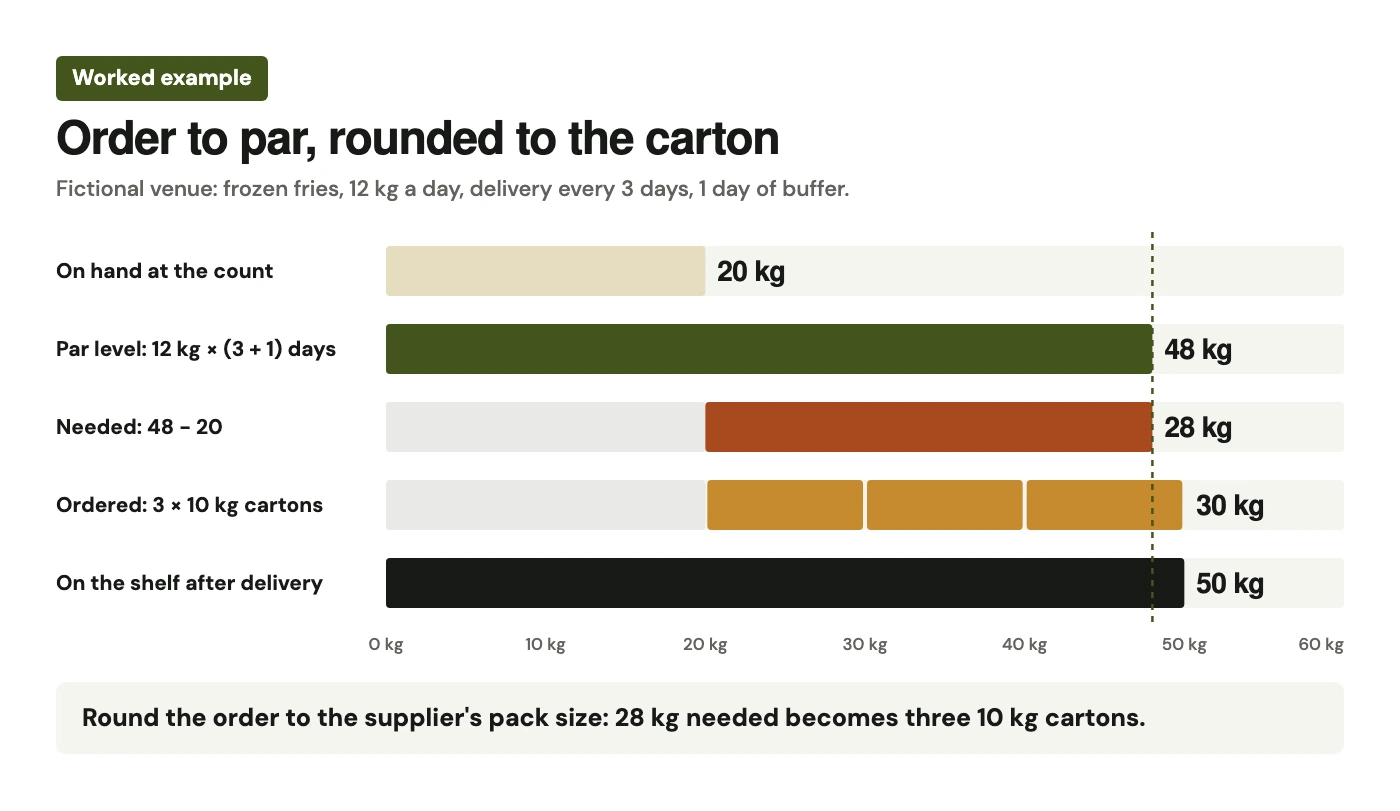
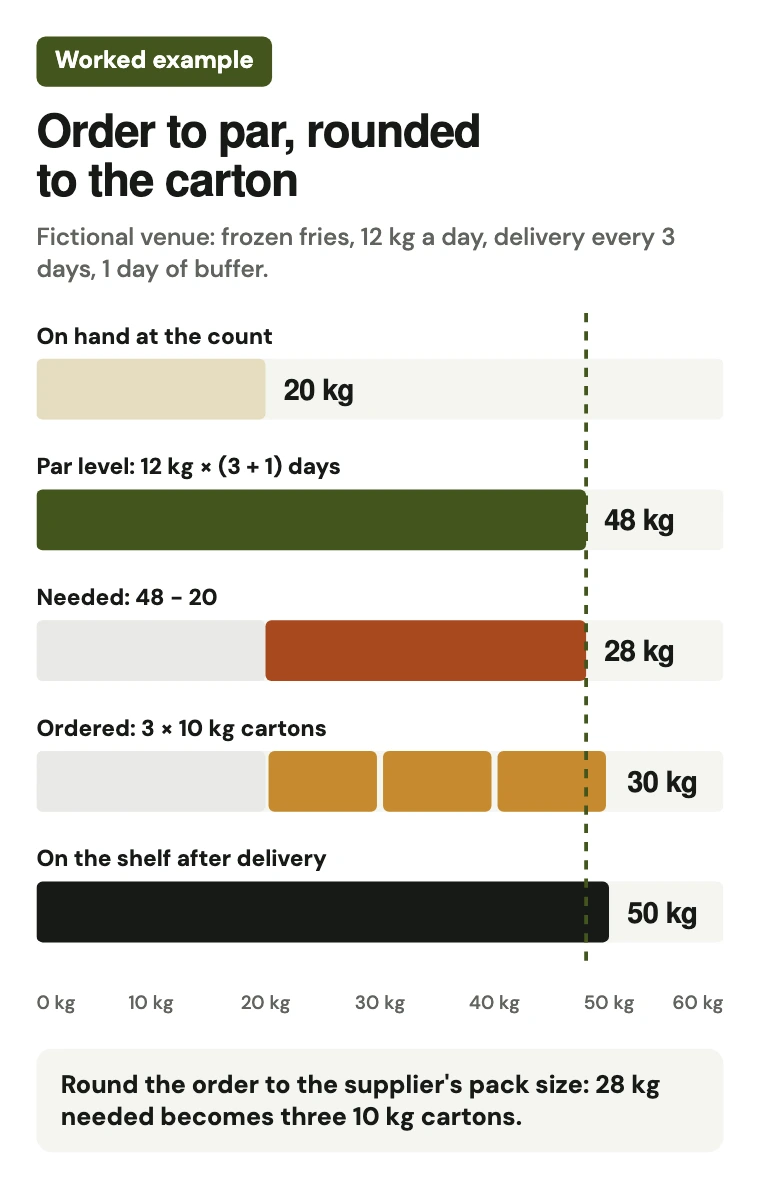
Par levels go stale. Recheck them when the menu changes, when the season changes a dish's sales, and when a supplier changes delivery days or minimum order quantities. Paul's point about frequency applies here: a par level is only as good as the counts behind it, and if you count once a month you miss the pattern.
05 / Counting
Pick a Counting Day and Keep It
Paul's rhythm for a small venue is a stocktake every week, done before the big order, so the count sets the order. When his team set up counts, the floor was every two weeks. A full count of everything at least monthly matches the textbook's minimum for a physical inventory to work as a control.[1]
[[wrap:steps]]
Count on the quietest day
Paul picks the quietest trading day for the count, often the Monday after a big weekend, and before the big order arrives.
Count in zones, in the same order every time
Freezer, cool room, dry store, bar. The same person or pair, the same route, the same units. Consistency matters more than speed.
Count the expensive lines more often
Between full counts, count the few items that carry most of your spend, such as proteins, cheese and spirits, more often. That is a perpetual count for the lines where a loss hurts.[1]
Close the period cleanly
Count at the same point in the day, with deliveries that arrive after the count left for the next period. A delivery counted on the shelf but invoiced next week makes one week look cheap and the next look dear.
[[/wrap]]
The year-end count is a tax matter as well. Under the ATO's simplified trading stock rules, a business with aggregated turnover under A$50 million can choose not to do a formal end-of-year stocktake if it reasonably estimates that the value of its trading stock changed by A$5,000 or less over the year.[7] If you do count, the ATO accepts three valuation methods for each item: cost, market selling value or replacement value.[8] Ask your accountant which applies to you. The weekly count is for running the business; the year-end figure is for the return.
06 / Two numbers from every count
Stock Used and Stock Turnover
Every count gives you two numbers worth tracking. The first is what you used: opening stock plus purchases minus closing stock.[3] The second is how fast stock turns over.
[[wrap:formula]]
Stock used = opening stock + purchases − closing stock
Use the same dates and the same item scope for all three. Divide food stock used by food sales for the same period to get your actual food cost percentage.
Stock turnover = stock used ÷ average stock
Average stock = (opening + closing) ÷ 2. Days of stock on hand = average stock ÷ stock used × days in the period.
[[/wrap]]
| Line | How it is worked out | Amount |
|---|---|---|
| Opening stock (1st of the month) | Last month's closing count | A$6,000 |
| Purchases in the month | Supplier invoices, ex-GST | A$14,000 |
| Closing stock (end of the month) | This month's count | A$5,000 |
| Stock used | A$6,000 + A$14,000 − A$5,000 | A$15,000 |
| Average stock | (A$6,000 + A$5,000) ÷ 2 | A$5,500 |
| Stock turnover | A$15,000 ÷ A$5,500 | 2.7 times in the month |
| Days of stock on hand | A$5,500 ÷ A$15,000 × 30 | 11 days |
The figures are invented to show the arithmetic. The textbook's rough guide is that stock turning over every one to two weeks, two to three times a month, is normal, and that a low turnover suggests too much money sits in stock.[1] Treat that as a starting point, not a target: a venue buying fresh produce daily turns faster than one carrying a wine list. If this venue cut average stock from A$5,500 to A$4,000 with the same usage, A$1,500 of cash would come off the shelves and back into the bank, once.
To turn stock used into a food cost percentage, with the adjustments for staff meals and transfers, use the step-by-step method in calculating actual food cost from your stock count.
07 / Usage against sales
Compare What You Used With What You Sold
The count tells you how much went out. Your POS and recipe cards tell you how much should have gone out. The gap between the two is where the money is. Paul describes the check in plain terms: if the recipes say you should have 8 kilos left and the count finds 1, "we know where a problem is."
Worked example, invented figures, one week of chicken thigh:
| Line | Kilos |
|---|---|
| Opening count | 6 |
| Delivered this week | 50 |
| Closing count | 5 |
| Used (6 + 50 − 5) | 51 |
| Sold, from POS × recipe portion | 44 |
| Logged as waste | 2 |
| Logged as staff meals | 1 |
| Explained (44 + 2 + 1) | 47 |
| Unexplained (51 − 47) | 4 kg, about A$44 at A$11/kg |
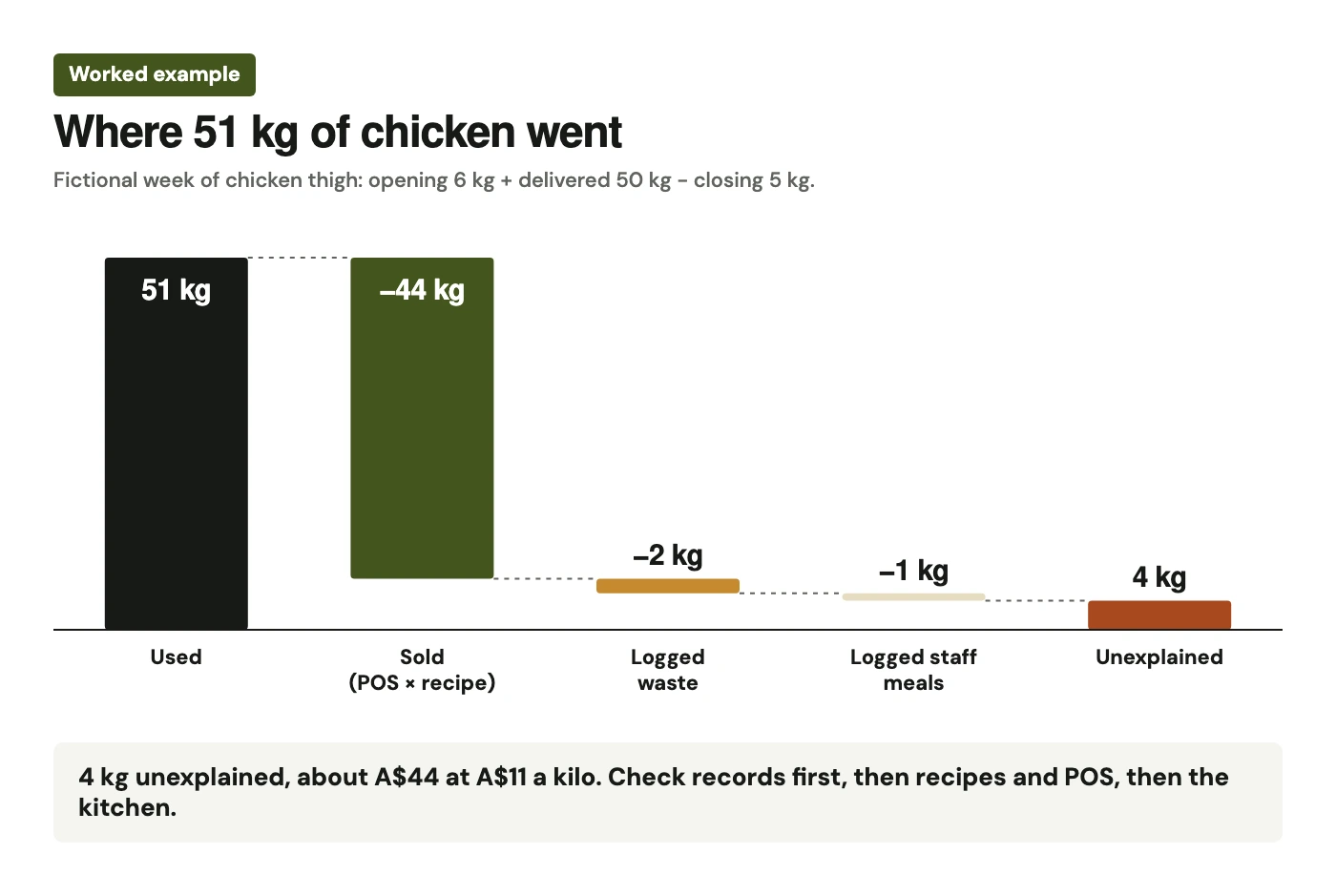
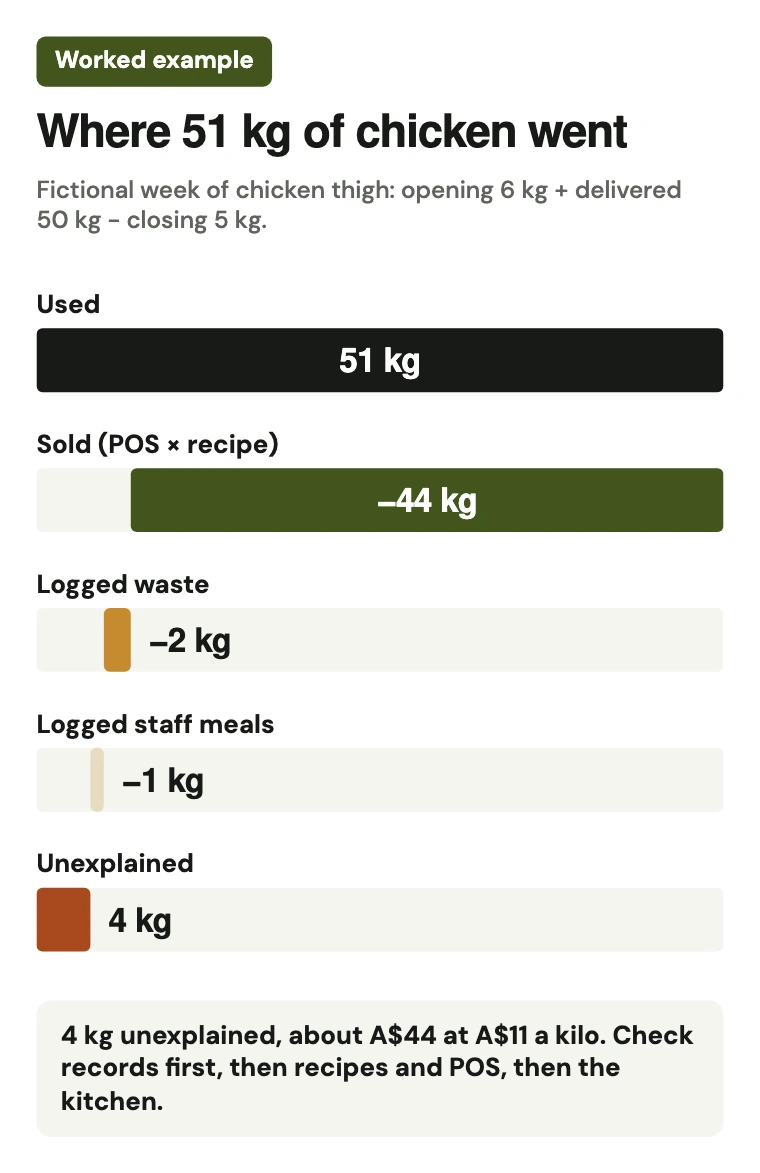
Investigate in this order, so a paperwork problem is not blamed on the kitchen: first the records (a missed invoice, a delivery counted in the wrong week, a transfer to another venue, a count error), then the recipe and POS setup (is every dish that uses chicken linked to the right portion?), and only then the kitchen (portion size, staff meals not recorded, theft). Paul's questions at this point are the same: staff meals, over-portioning, or stock walking out the door.
Waste you write down is explained loss; waste you don't is unexplained. That is why the waste log and the stocktake belong together. The guide to keeping a restaurant waste log covers what to record.
08 / Sheet or software
Get the Routine Right Before You Buy a System
Inventory software linked to the POS can take each sale off stock automatically and keep a running balance of what should be on the shelf.[1] It only works if the recipe cards, POS buttons and counts behind it are right. Paul's advice to small venues is to learn the routine on a sheet first; you will know which software you need once the manual work becomes the bottleneck. When you get there, our inventory software checklist lists the questions to ask.
[[wrap:box#weekly-stock-routine]]
Weekly stock routine
- Count the high-value lines on the same day each week, before the big order.
- Order each item up to its par level, rounded to the pack size.
- Check every delivery: temperatures, use-by dates, quantities.
- Check every invoice price against the stock list before approving payment.
- Rotate stock: first in, first out; label and date every container.
- Enter the week's waste log totals.
- Once a month, count everything and work out stock used and days on hand.
- Compare usage with sales for your top five ingredients and chase the biggest gap.
- Recheck par levels when the menu, the season or a delivery day changes.
[[/wrap]]
[[wrap:limits]]
This is a management guide, not food safety, accounting or tax advice. The worked figures are invented to show the arithmetic and are not industry benchmarks. Food safety obligations depend on your business category and your state or territory; check with your local council. Ask your accountant about stock valuation and the year-end stocktake.
[[/wrap]]
09 / Questions
Questions About Inventory Management
What is inventory in a restaurant?
Restaurant inventory is the food, drink and sale packaging you have bought but not yet sold, counted in units and valued at what you paid. Inventory management is the routine around it: a stock list, checks when deliveries arrive, first-in-first-out storage, orders to par levels, and regular counts that you compare with sales.
Think of inventory as three things at once. It is product: the ingredients the kitchen needs to cook today's menu. It is cash: every carton was paid for, or will be, before it earns anything. And it is a measurement: the opening and closing counts are what turn a pile of supplier invoices into a real cost of food for the period.
Two record methods sit underneath. A perpetual inventory keeps a running balance per item, adding deliveries and taking off usage; most small venues keep one only for expensive lines such as proteins and spirits. A physical inventory, or stocktake, counts everything on the shelves at set intervals and values it. The physical count checks the perpetual one: if the records say 20 and the shelf has 15, something needs explaining.
What belongs in the count: food, beverage, and the packaging you sell food in. Cleaning products and smallwares are usually tracked separately so they don't distort food cost. Prepared items, such as sauces, stocks and portioned proteins, should be counted too, valued at the cost of their ingredients, or your closing stock will be understated.
Inventory management is not a once-a-year job for the tax return. Done weekly on the main lines, it shows you within days when stock is going off, going missing or piling up.
How do you make an inventory list for a restaurant?
List every item you buy regularly in the order it sits in your storage areas, then add the count unit, the latest invoice price per that unit, the supplier, the storage zone and a par level. Keep it in a spreadsheet so the price updates as invoices arrive and the totals calculate themselves.
Start with your supplier invoices from the last month. Every line on them is a candidate for the list. Group items by where they live: freezer, cool room, dry store, bar, packaging. Within each zone, order the rows the way the shelves run, so whoever counts can walk the room once and not go back.
For each item, fix the count unit. Some things are counted in kilos, some in cartons, some in bottles or units. Whatever you choose, the price on the sheet must be per that unit. If you buy a 10 kg carton for A$45, and count in kilos, the price is A$4.50 per kilo. Write the conversion on the sheet so nobody has to guess.
Add the par level, the amount you want on hand to reach the next delivery, and the supplier. Now the count sheet doubles as an order sheet: count, subtract from par, round to pack size, order.
Include prepared items and opened stock. Half a tub of mayonnaise is still stock. Count it in a sensible fraction or by weight.
Finally, add a total value column: quantity on hand times price per unit. The sum of that column is your closing stock value, which you need to work out food cost for the period. Review the list whenever the menu changes, because new dishes bring new items and retired dishes leave dead stock behind.
How much inventory should a restaurant carry?
Carry enough of each item to reach the next delivery plus a short buffer, and no more. For perishables that is often a few days; for dry goods and drinks it can be longer. A culinary management textbook treats stock turning over every one to two weeks as normal; less often means too much cash sits on the shelves.
The par level formula answers the question item by item: average daily usage multiplied by the days until the next delivery plus a buffer. A venue that uses 12 kg of fries a day, with deliveries every three days and one day of buffer, needs a par of 48 kg. Anything well above par is cash you have spent early.
At the whole-venue level, two numbers tell you if you are carrying too much. Stock turnover is stock used in the period divided by average stock. Days of stock on hand is average stock divided by stock used, times the days in the period. In the worked example in this guide, a venue using A$15,000 of stock a month with A$5,500 average on hand turns stock 2.7 times a month and holds about 11 days of stock.
There is no single right number for every venue. A cafe buying bread and milk daily will turn stock faster than a restaurant with a long wine list or imported dry goods. Compare your own figure month to month: if days on hand creep up while sales stay flat, stock is building somewhere.
Watch shelf life before you chase bulk discounts. Buying a month of a perishable to save on price can cost more in spoilage than the discount was worth, and the waste log will show it.
How often should a small restaurant count inventory?
Count your high-value items every week, ideally on the same quiet day before the main order, and do a full count of everything at least once a month. Paul's rhythm for small venues is a weekly stocktake before the big order, with every two weeks as the floor, because monthly counts miss too much.
A weekly count of the main lines does three jobs. It sets the order, because you order up to par from what is actually on the shelf. It catches problems while they are fresh: a missing case of wine or a cool room full of slow-moving stock shows up within days, not weeks. And it gives you a weekly figure for stock used, which you can compare with sales.
The full count matters because the small lines add up and because it resets the records. A culinary management textbook says a physical inventory should be taken at least monthly to work as a control. In his own venues, Paul timed the bigger full counts around long weekends and public holidays.
Make counts quick enough that the team will do them. Count in zones, follow the shelf order on the sheet, use the same units every time, and have the same person or pair count where possible. Count at the same point in the day, before deliveries arrive, so deliveries fall into the right period.
The year-end count for tax is separate. Under the ATO's simplified trading stock rules, a business with aggregated turnover under A$50 million may not need a formal end-of-year stocktake if it reasonably estimates the value of its stock changed by A$5,000 or less. Your accountant can confirm whether that applies.
[[wrap:cta]]
Find Where Your Margin Leaks
Stock and waste are two of the four places a venue loses margin; menu and labour are the others. The free two-minute venue scan asks about all four and shows which to fix first.
Take the 2-minute venue scan ↗
[[/wrap]]
- BC Cook Articulation Committee, Basic Kitchen and Food Service Management, ch. 8 "Basic Inventory Procedures" (CC BY 4.0)
- BC Cook Articulation Committee, Basic Kitchen and Food Service Management, ch. 9 "Purchasing" (par levels)
- BC Cook Articulation Committee, Basic Kitchen and Food Service Management, ch. 14 "Monthly Food Costs"
- Food Standards Australia New Zealand, Keeping food at the right temperature
- Food Standards Australia New Zealand, Receiving food
- Food Standards Australia New Zealand, Standard 3.2.2A: food safety management tools
- Australian Taxation Office, Simplified trading stock rules
- Australian Taxation Office, Valuing trading stock
- Australian Taxation Office, GST-free food
- Food Standards Australia New Zealand, Evidence tool (Standard 3.2.2A)

Founder of Hospo Dojo, hospitality consultant and mentor, with kitchen design and foodservice consulting work.

LAUNCHING YOUR
FOOD SERVICE VENUE?
Explore our hospitality consulting and commercial kitchen design services, or get in touch to talk through your venue.
Book a consultation